
Is Starting Small Better for Climate Policy?
In October 2026, the United Nations Environment Program (UNEP) announced that efforts to keep global temperatures from rising more than 1.5°C had failed. The new minimum temperature rise by mid-century was estimated to be between 1.7° and 2°C.
This seemingly small shift in global temperature overshoot has vast consequences for vulnerable regions around the globe. UNEP Executive Director Inger Andersen stated that “every additional fraction of a degree […] increases climate impacts,” including risks of floods, heatwaves, and wildfires. Andersen added, “It is not time to throw in the towel and give up,” emphasizing the importance of maintaining the lowest possible temperature overshoot. Yet, reaching this goal would require states to reduce their current emissions by over 18 per cent by 2030 and 45 per cent by 2035.
The UNEP’s surrender of its 1.5°C limit, a defining goal of the 2015 Paris Climate Agreement, is a blow to international climate preservation efforts. This setback in global temperature limits and the shift in strategy to a reactive “overshoot, peak, and decline” approach suggest that the climate treaty is floundering, unable to meet its goals. In a period of such divided political relations and international strife, a comprehensive international agreement to fight a climate crisis seems more a dream than an achievable reality.
And yet, that dream has been achieved before. In 1987, the Montreal Protocol was designed to salvage the Earth’s protective ozone layer following the discovery of the ozone hole over Antarctica. Beginning with only 24 signatory states, the Montreal Protocol grew into one of the first treaties to achieve universal ratification. It has seen great success in removing ozone-depleting substances (ODS) from widespread use. For instance, the Protocol’s members have phased out 98-99 per cent of ODSs compared to 1990 pollution levels, removing the equivalent of 135 gigatons of CO2 from the atmosphere.
Further, the Montreal Protocol was amended multiple times to speed up the ozone removal process. Meanwhile, the Paris Agreement’s goal of maintaining a 1.5°C increase proved infeasible and was amended to cap the temperature increase at 1.7°C to 2°C. In analyzing the failures of the Paris Agreement, the Montreal Protocol provides a stark contrast in terms of scope, methodology, and effectiveness.
At their respective inceptions, the Montreal Protocol and the Paris Agreement adopted opposite approaches to combat the climate crisis. In 1987, a relatively small number of nations negotiated the Montreal Protocol. It had just 24 initial signatories, and plans outlined only a partial phase-out of ODS from widespread use. After initial success, the Protocol was amended six times (most notably in 1995, 2007, and 2015) to increase both its speed and scope; the amendments expanded the agreement to include more ODS types and accelerated the timeline for their removal. In this sense, the Protocol operated on an outward-expanding strategy; it began with small, focused goals and upon success, revised to pursue larger, more ambitious ones.
The Paris Climate Agreement, however, started with a broader, more ambitious ideology. Rather than steadily increasing its membership, it was initially signed by all UN members. Instead of expanding its aims, it began with broad declarations and goals, such as “foster[ing] climate resilience,” “lower[ing] greenhouse gas development,” and developing “a pathway toward a lower-carbon future” without outlining strategies to focus those aims. It also asked states to develop and report on individual climate regulations rather than to create a focused international strategy, leading to concessions such as the aforementioned 1.5°C threshold. While both strategies have merit, the Montreal Protocol’s expansion was more successful than the Paris Agreement’s broad goals due to its attainable objectives and specific strategies.
One reason for the Montreal Protocol’s successful expansion was trade. It was able to coax states into signing it by linking it to trade regulations, preventing member states from trading ODS with non-member states and imposing restrictions on the import and export of goods. This trade-prevention policy created an incentive for all states to sign on or lose trade access. Additionally, the Montreal Protocol’s gradual phase-out plan allowed member states time to develop alternatives to ODSs.
The Paris Agreement, however, did not contain similar incentives for states to join or comply, nor did it outline structured plans. Its numerous goals included vague intentions to enhance state capacity to combat climate change and to increase access to information, without implementing specific strategies to reduce global temperatures. Instead, the burden of tracking, declaring, and reducing emissions fell to individual states, which were left to implement climate policies independently.
The Montreal Protocol also included support for developing states, particularly in the form of financial and technological aid. The Multilateral Fund, created by donor states and run by the Protocol’s Executive Committee, exemplifies this support: over the past 35 years, it has provided more than $5.5 billion to ozone-reduction projects in developing states through technological assistance, training, capacity building, and industrial conversion. Meanwhile, the Paris Agreement’s support for developing nations relied on voluntary contributions: it stated that developed nations have a responsibility to support developing states, but failed to include specific mechanisms to organize this funding.
The success of the Montreal Protocol can therefore be largely attributed to the gradual implementation of its goals and increase in reach. By starting with an attainable set of objectives and expanding them over time, supporting developing nations, and incentivizing states to participate, the Protocol managed to gain and maintain signatories. However, the Paris Agreement’s lack of focused, well-defined goals and mechanisms to help states achieve them has contributed to its recent policy setbacks. Its ambitious goals failed to drive the agreement forward, instead leading to ineffective climate policies.
Clarifying the Paris Agreement’s goals and returning from a global temperature overshoot towards 1.5°C is not altogether impossible. Principles from the Montreal Protocol could be used to alter the agreement, outlining clearer strategies and incentives to cut emissions. However, applying these principles would prove difficult because the policies have fundamentally opposite central approaches. Rather than fully reforming the Paris Agreement to mimic the Montreal Protocol, UNEP could use the Protocol’s outward-expanding methodology to advance specific goals of the Paris Agreement. Incorporating the Protocol’s strategies — such as a central fund to support developing states, trade restrictions on non-compliant nations, and step-by-step plans for every goal — into specific areas of the agreement may help centralize and focus states’ responses, yielding better results than current individual efforts. Legislation inspired by the Montreal strategy may well achieve climate preservation goals that seem as impossible now as restoring the ozone layer did in 1987.
Edited by Laura Ridoux
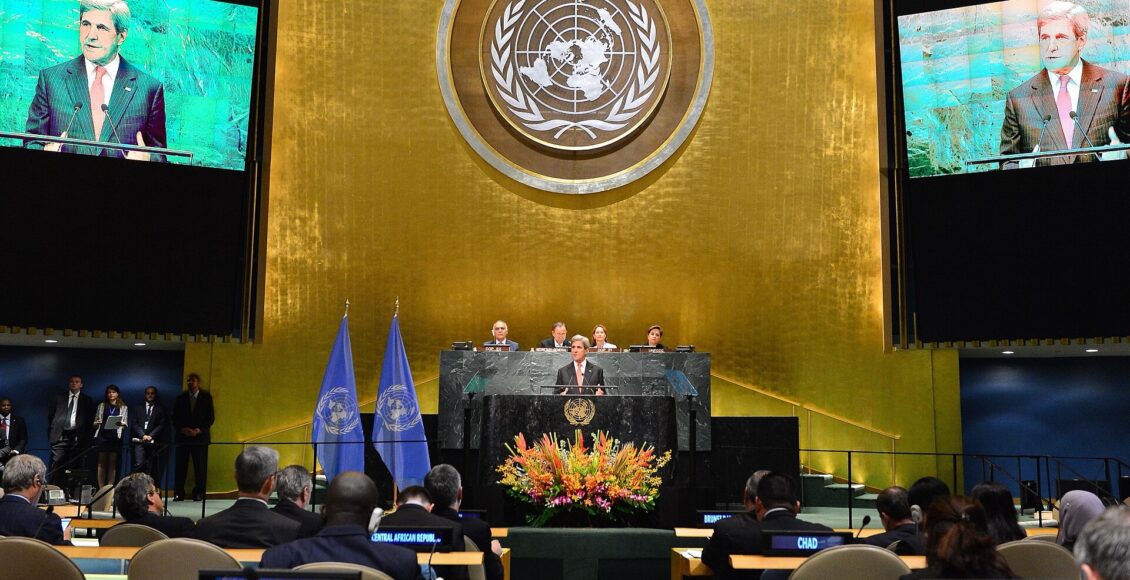
Featured image: In 2016, US Secretary of State John Kerry delivered remarks at the UN General Assembly about the signing of the Paris Agreement. Photo from the US Department of State is in the public domain.


