
What is Haiti’s Gang Suppression Force Really Fighting For?
Since the July 2021 assassination of President Jovenel Moïse, armed gangs, including the coalition Viv Ansanm, have steadily outgrown a Haitian state that can neither defeat them nor negotiate its way past them. Violence has now forced the postponement of the December 2026 legislative and presidential elections, leaving it nearly a decade since Haitians last voted. To many, there seems to be no way out but to fight.
The Gang Suppression Force (GSF), a United Nations-sponsored military and police force, was originally authorized in September 2025 for a 12-month period. This September, Resolution 2928 extended its mandate by six months. Its head, Jack Christofides, told the Security Council in April 2026 that the force aims to “degrade the operational capacity of gangs to a level that Haitian institutions can sustainably manage.”
The GSF succeeds the Kenyan-led Multinational Security Support Mission (MSSM), whose 22-month run ended when its last contingent left Haiti’s capital, Port-au-Prince, in April 2026. With an authorized ceiling of 5,500 military and police personnel and support from 50 civilian staff, the GSF was believed to be a more robust response to the previous mission’s on-the-ground frustrations.
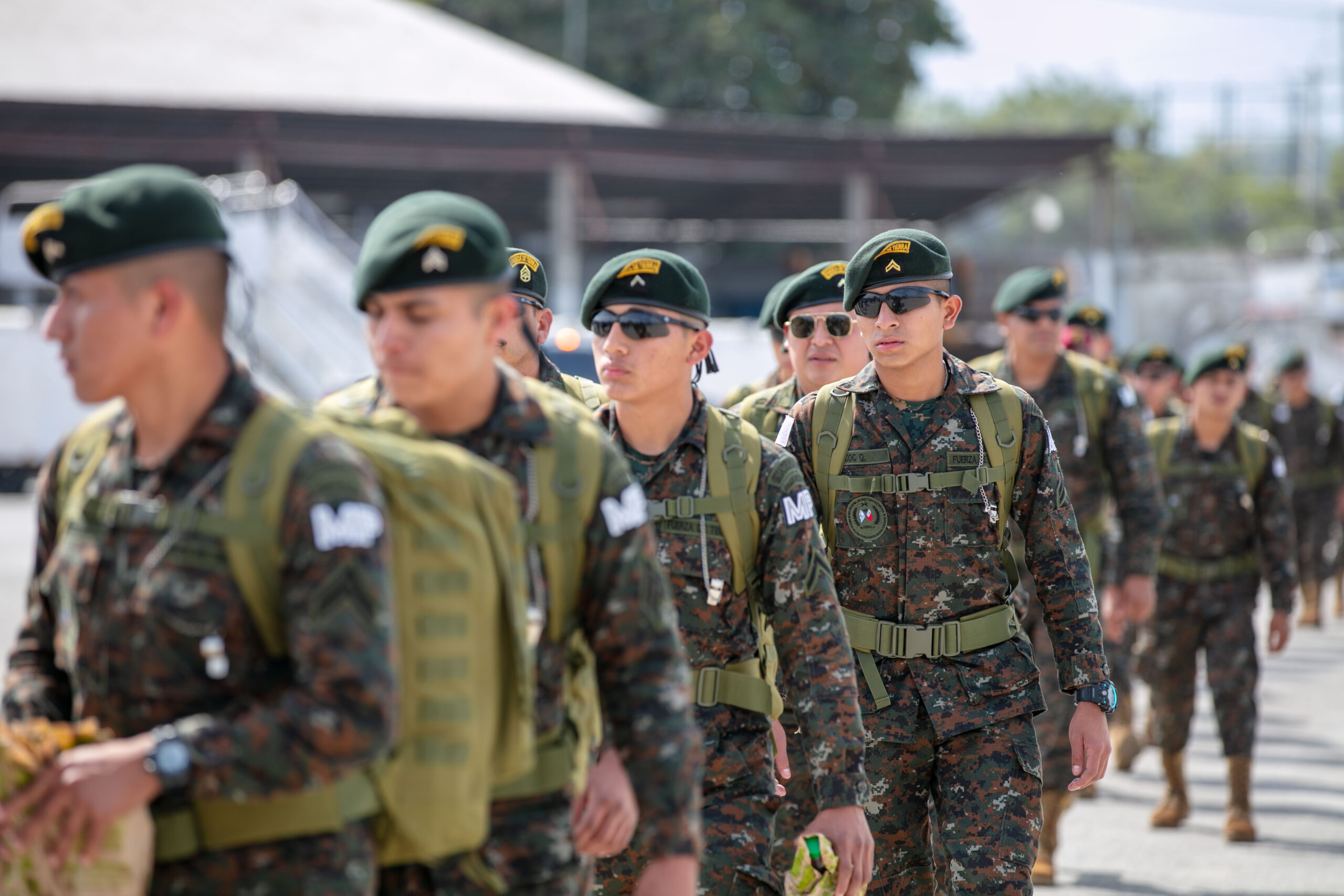
Unlike the MSSM, whose mandate was largely confined to supporting the Haitian National Police (PNH), the GSF is authorized to conduct independent operations alongside joint missions with the PNH. Its deployment thus far has fallen considerably short of that ambition. As of August 31, only 1,166 uniformed personnel from six countries—Chad, Sri Lanka, Guatemala, El Salvador, Mongolia, and Jamaica—had arrived, representing just 21 per cent of its supposed size. The MSSM, for its part, never deployed more than 1,000 of the 2,500 personnel it was authorized to field.
With 90 per cent of metropolitan Port-au-Prince still under gang control and some 1.5 million Haitians internally displaced, it is hard to see how the GSF can fulfill its mandate with only a fraction of its authorized personnel. The capital’s dense, informal neighbourhoods and narrow, hard-to-reach streets complicate operations for forces unfamiliar with the terrain, and armed groups have shown they can simply regroup elsewhere when pressed. In localities beyond the capital, the GSF has yet to reach communities most at risk, where its work would be most keenly felt.
According to the UN Panel of Experts’ September 2026 report, armed groups have launched coordinated attacks across dozens of localities in the Artibonite Department while extending their influence over towns and transport corridors in Central Haiti. Yet as of August 31, the GSF has established only four operational bases, three in Port-au-Prince and one in Gonaïves.
In Mirebalais, 60 km north of Port-au-Prince, 400 Mawozo and Canaan gangs stormed the town on March 31, 2025, causing thousands to flee and prompting the shutdown of one of Haiti’s foremost medical institutions, the University Hospital. Nearly nineteen months later, the gangs continue to hold the deserted settlement and the routes around it. This has put extreme strain on neighbouring facilities; Dr. Wesler Lambert, the executive director of the NGO that operated the now-closed hospital, reported that at the nearby Belladère Hospital, monthly cesarean sections had risen from around 16 to above 80.
Meanwhile, the Haitian government’s parallel reliance on private security contractors complicates any assessment of the GSF’s successes. Human Rights Watch documented at least 1,243 deaths in 141 drone strikes carried out between March 2025 and January 2026, including 43 adults reportedly unaffiliated with criminal groups and 17 children. The United Nations Integrated Office in Haiti has attributed these operations to a specialized task force established by Prime Minister Alix Didier Fils-Aimé and supported by the private military company Vectus Global. After founder and former Blackwater CEO Erik Prince secured a 10-year contract with the Haitian government, Vectus Global received a US State Department licence to provide defence services in Haiti.
If these were extrajudicial killings, as now appears likely, the suppression force’s record is entangled with a campaign that answers to a different command and stands accused of unlawful conduct. This blurs an already contentious picture of the GSF, further casting doubts on its effectiveness.
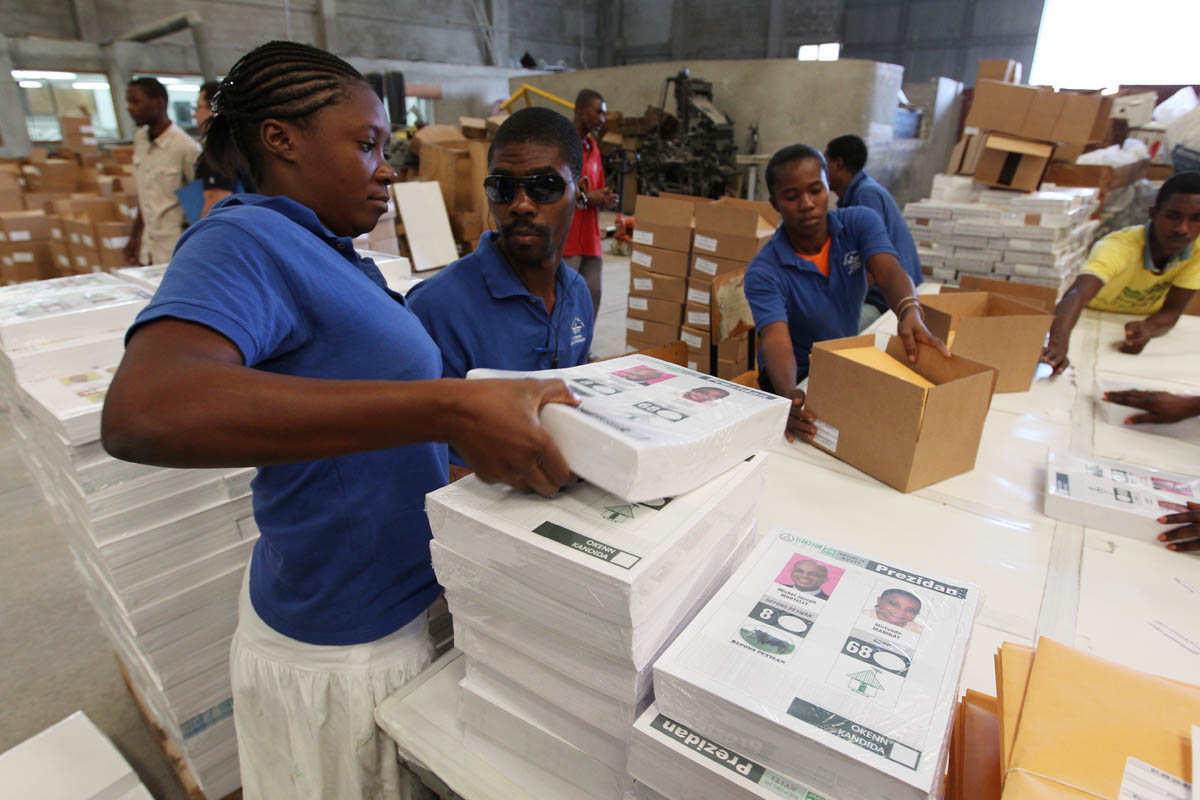
The uncertainty surrounding the Haitian electoral timetable is part of the greater narrative and motive that undergirds the importance of an effective force. After nearly a decade without national elections, the need for a resolution through the ballot box has seldom been more pressing, with over 930,000 new voters registered since June 2026. Yet what kind of political leadership can such elections realistically be expected to produce? Among the candidates of the 326 parties allowed to run in the now-delayed December 2026 contests, some have been previously sanctioned by Canada and the US over alleged involvement in corruption, illicit trafficking, and support for armed gangs.
Former President Michel Joseph Martelly, for instance, has been seeking a return to power under the banner of a new political coalition. Martelly’s presidency, spanning 2011 to 2016, was marred by allegations of widespread corruption, particularly over the management of PetroCaribe, a Venezuelan initiative that allowed Haiti to purchase oil on preferential credit terms and redirect funds toward infrastructure and development. Between 2008 and 2018, the arrangement generated about $4.23 billion USD in financing for the Haitian state. Yet audits by Haiti’s Superior Court of Auditors uncovered irregularities, including overbilling, favouritism, and payments for unfinished projects. A 2023 UN Panel of Experts report identified Martelly’s presidency as the period of the most serious diversions, noting that his prime minister, Laurent Lamothe, approved $668.8 million USD for 149 projects. Across the broader program, $1.74 billion USD was earmarked for over 490 development projects, of which 92 per cent ($1.6 billion USD) was spent under questionable authorizations, while virtually none of the projects were completed. An IMF assessment subsequently estimated that $2 billion USD had been embezzled or wasted on projects of little value. By August 2023, Haiti was still paying about $10 million USD per month toward its PetroCaribe debt.
Herein lies a paradox: elections are expected to restore the legitimacy of a state whose political establishment has, in part, been implicated in the very insecurity that has made those elections impossible. Thus, to what ends is the GSF working? Will it facilitate the return of peace, or consolidate the power of corrupt politicians whose ambitions have helped entrench an ineradicable warlordism in today’s Port-au-Prince?
As the GSF struggles to fulfill its mandate, the prospect of an eighth UN peacekeeping mission under the Blue Helmets may well return to the fore. Yet Haiti’s troubled history with interventionism offers little assurance that another change of uniform would bring a change of circumstances. For a country where peace has so often been promised and so seldom sustained, hope has grown scarce on this side of the island.
Edited by George Wu
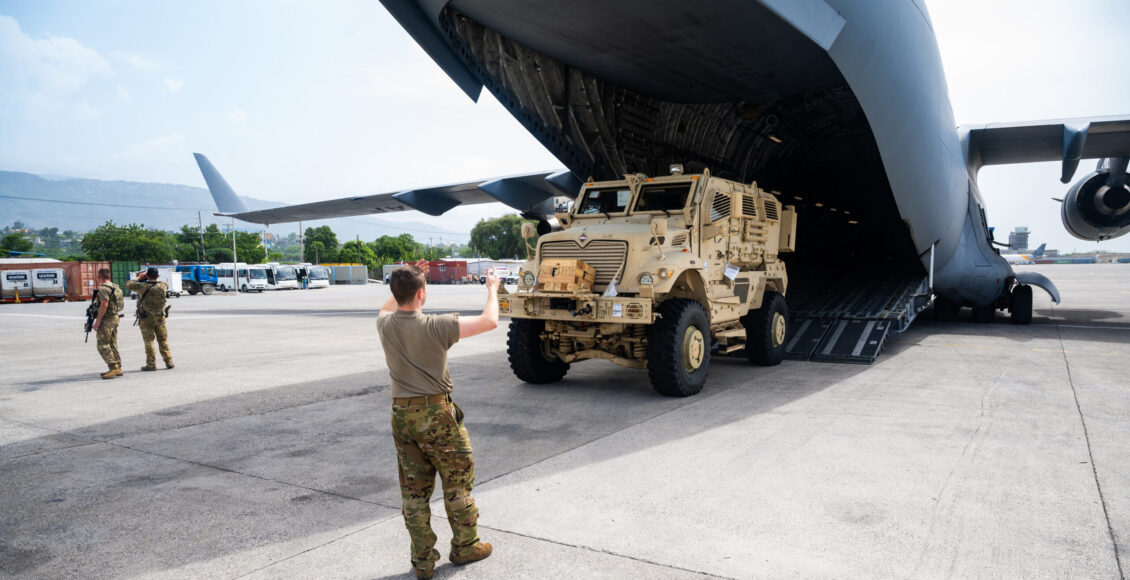
Featured Image: U.S. Air Force Airman 1st Class Gabriel Kilgore, a loadmaster assigned to the 14th Airlift Squadron, offloads a Mine Resistant Ambush Protected (MRAP) MaxxPro vehicle at Toussaint Louverture International Airport in Port-au-Prince, Haiti, on July 7, 2024. Photo by Senior Airman Mitchell Corley is in the public domain.

